

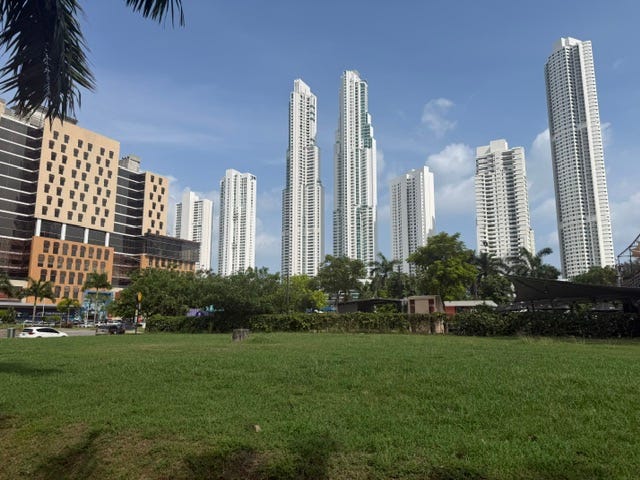
Environment for the Americas and our partners are using satellite imagery to assess light pollution in Panama City, Panama. Each year, millions of birds pass through Panama, a geographic bottleneck between North and South America that funnels migratory birds through a narrow corridor. Most fly at night and rest along the coasts by day. But artificial light can disorient them, draw them into cities, and lead to deadly collisions with buildings. Panama City is where these threats meet. It sits directly on the migration corridor, and a dense skyline of glass towers rises throughout the city, creating an obstacle and a threat for migrating birds.
For the past two years, Environment for the Americas and AdoptaBosque have worked together to address light pollution and window collisions in Panama. Our efforts go beyond the science, incorporating policy advocacy and community engagement to help reduce light pollution and bird collisions and protect habitats along migratory routes.
A bridge for night travelers
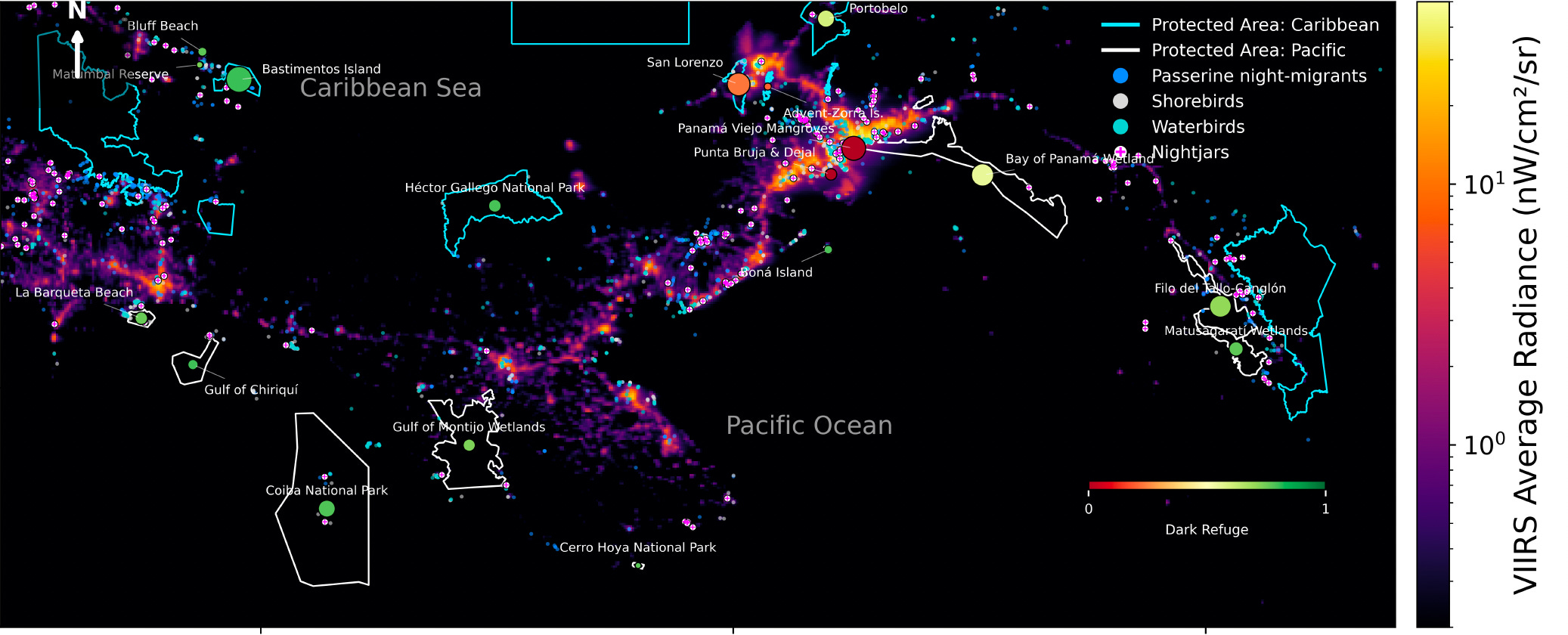
Twice a year, warblers, thrushes, shorebirds, and nightjars pass through Panama. Between 2015 and 2025, radio towers across the country detected 193 tagged night migrants. Passerines made up 151 of them, and Swainson’s Thrush was the most frequently detected. (Fig 1)
These birds navigate by the stars and the Earth’s magnetic field, and they depend on dark, quiet places. Bright lights pull them off course. Drawn to lit buildings, they circle until they are exhausted or collide with glass.
What our partnership found
Together with Eficiencia Energética y Ambiente de Panamá, NASA, and AdoptaBosque, EFTA analyzed fourteen years of nighttime satellite images and more than 180,000 bird records across 19 protected areas on Panama’s Caribbean and Pacific coasts.
Between 2012 and 2025, night light grew around the country’s cities and roads, and its color changed. Photographs from the International Space Station show Costa del Este, a district bordering the Bay of Panama wetland, one of the country’s most important bird sites, glowing orange under sodium lamps in 2012 and white under LEDs in 2025.
That shift matters as much as the added brightness. White LEDs emit a large amount of blue light, a short wavelength that disorients migratory birds, suppresses the melatonin that regulates their sleep, and draws them into urban areas. Satellites cannot detect blue light, so our maps likely understate the glare that birds experience.
Light is only part of the collision problem. Glass is the other major danger. Clear glass shows birds the sky or plants behind it, and mirrored glass reflects them, while concrete is easy for birds to see. Costa del Este has more than 50 towers of 20 floors or higher, many faced with lit glass, standing beside the wetland.
Protecting the journey together
In Panama City, we’re working with building managers and owners to encourage practical steps that reduce window collisions. This work also helps show how the Bird City Network can focus attention and action on the most significant threats to birds where they occur. The Bird City Network, led by Environment for the Americas and American Bird Conservancy, connects Bird City programs across the Americas. Each program recognizes communities that take documented action for birds, such as improving habitat and addressing threats like window collisions. Participating programs share resources, training, and ideas, so what works in one city can help another.
We’re grateful for our partnership with AdoptaBosque, whose local leadership and strong community connections are essential to this effort. Eficiencia Energética and Ambiente de Panamá contribute the technical expertise needed to translate light pollution data into practical guidance. Environment for the Americas is proud to support both partners as we work toward safer urban environments for migratory birds.
This October, as birds travel overhead under the cover of darkness, the choices we make on the ground matter. Together, we can reduce the threats they face and help make their remarkable journeys safer.
What you can do
The call to action is simple wherever you live along the flyway: turn off unnecessary lights to protect migrating birds. Panama’s geography funnels millions of migrants through a narrow corridor, making dark skies especially important. Every light turned off helps create a safer passage. At home, turn off unnecessary outdoor lights from 11 p.m. to dawn, choose warm amber bulbs, and shield lights downward. Businesses can help by switching off decorative, rooftop, and facade lighting during migration seasons (March–May and August–November), closing blinds at night, and using bird-safe glass in new or renovated buildings. Municipalities can support birds by using warm, shielded LEDs near coasts and wetlands, keeping new lighting away from the seven dark refuges, and supporting bird-collision counts and night-sky monitoring. Every light turned off helps create a safer passage for migratory birds.